

Your Team Uses AI Daily. Great, Until It Makes You Irrelevant.
“It’s not for me, it’s for my team!” We are not talking about AI… but google. A forgotten 2009 report explains why managers who delegate hands-on use become obsolete, and why the AI trap is worse.

When companies hire for media roles today, they don’t just want people with extensive network and relationship managers; they want operators. They need people who can distinguish a real technical constraint on Meta or Amazon from a padded timeline. People who never log into the platforms can’t ask the right questions.
The same pattern is playing out across every function Gen AI touches, it will be more and more difficult to manage what you can’t understand.
IT is the function where adoption is strongest, so let’s look at the data. The productivity narrative seems overwhelming: major 2025 surveys from Atlassian, JetBrains, and DX all report massive gains, with some developers saving over 10 hours a week.
But here’s the surprise: self-assessment is unreliable.
A rigorous 2025 METR study found that experienced developers working on familiar codebases estimated AI increased their productivity by 20%, but objective measurement showed a 19% decrease. The developers themselves couldn’t tell whether AI was helping or hurting.
If experts working with the tools daily can misjudge their own productivity by nearly 40 percentage points, how can a manager who only uses AI occasionally evaluate their team’s estimates?
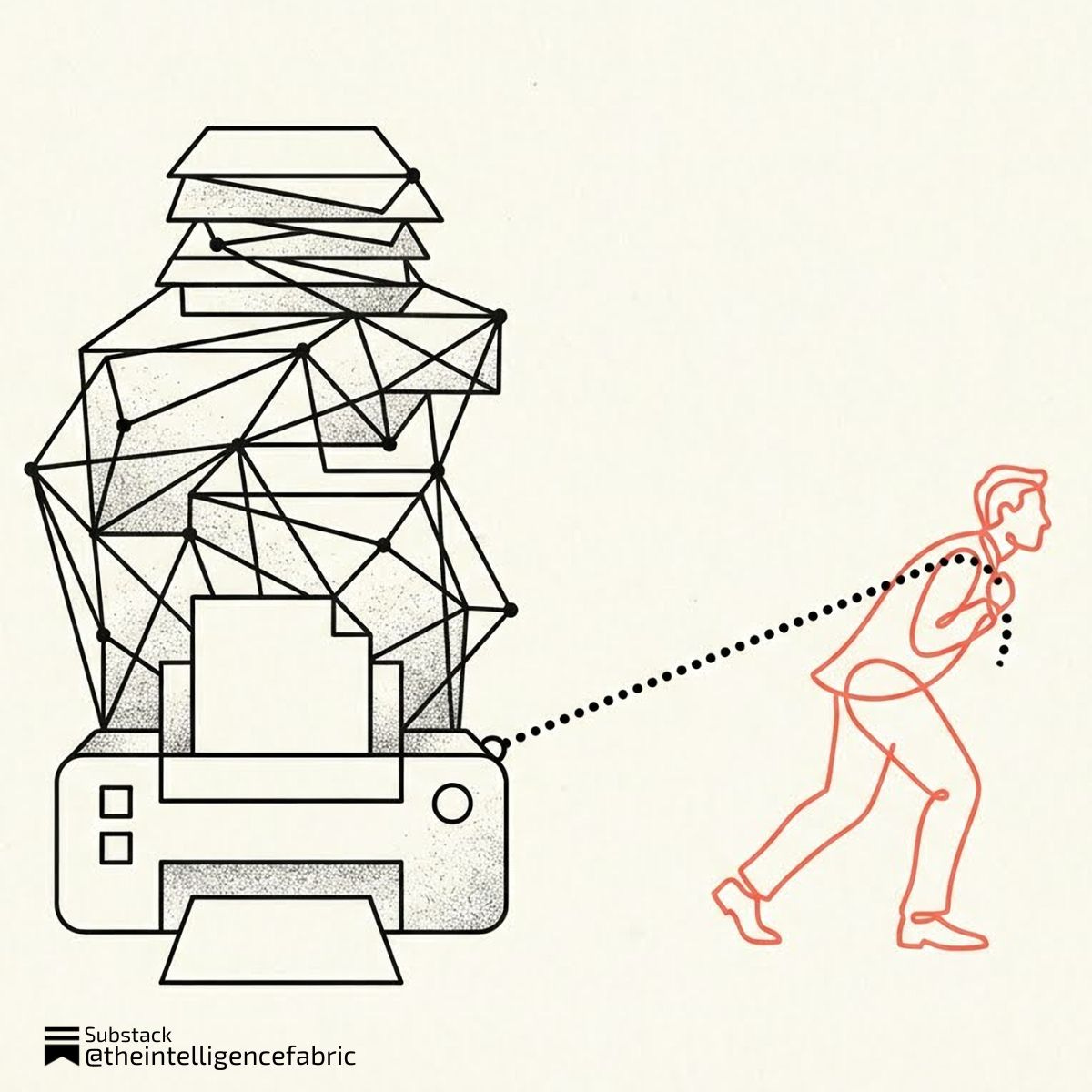
Such managers aren’t lazy. They are falling into Delegation Blindness: the trap where outsourcing hands-on work creates exactly the information gap that makes coordination impossible.
We have been here before.
The 2009 Playbook
In 2009, Forbes and Google partnered on a whitepaper called “The Rise of the Digital C-Suite.” They surveyed hundreds of executives on how they adapted to the internet, the mobile and the role of search.
The Losers: Generation Wang
The report identified executives over 50, the “Generation Wang”, who treated the internet as a task to be delegated. 40% never used their mobile devices for work. A significant portion operated on summaries prepared by others. Because they never saw raw information, they couldn’t question flawed assumptions. Their refusal to adapt went from a status symbol to a sign of incompetence.
The Winners: Generation Netscape
The executives who thrived were different. 51% preferred to locate information themselves and 35% used their mobile daily for work. Why? Because they understood that using Google wasn’t secretarial, it was strategic.
Rob Shaddock, CTO of Tyco Electronics, explained the difference: with online search, you could “go as deeply as you want” in whatever direction you needed. “Newspapers and print are static. Often an article leaves you with just so many additional questions but no further options.” The report identified a rising “Generation Netscape,” leaders who were “orders of magnitude more willing to try new ways to access information.” Executives who delegated got polished summaries. Executives who searched got intuition.
Why Delegation Erodes Authority
The 2009 lesson was clear: delegation creates blindness. But AI doesn’t just create blindness; it dismantles the manager’s authority.
Harvard Business School researchers discovered that AI creates a “jagged frontier.” Tasks that look equally difficult sit on opposite sides of the line: AI handles one brilliantly (e.g., making sense of a complex data) and fails at the other (e.g., looking up a number in a table).
Navigating this requires Frontier Fluency, aka knowing where the boundaries sit. You only get this by bumping into them. Managers who delegate lose the two pillars that make management possible:
1. The Knowledge Inversion In the past, seniority equaled expertise. AI breaks this. Erik Brynjolfsson found that AI raises the performance of new workers dramatically, closing the gap between junior and senior outputs instantly. Simultaneously, your team is learning the tool’s nuance daily (“The model hallucinates on revenue recognition”). You aren’t. The knowledge flows upward, but the org chart doesn’t. You can no longer mentor them, because they know more than you about the primary lever of their work.
2. The Judgment Collapse You are discovering the frontier for your occasional tasks, not their specialized work. Your mental model of what is “easy” or “risky” is calibrated to the wrong terrain. You approve timelines and allocate headcount based on a map that doesn’t match their territory. Your team knows it. How long before everyone else does?
“But surely,” you’re thinking, “leaders can’t do everything themselves.”
Of course. The point isn’t to do your team’s work. It’s to maintain enough hands-on familiarity to coordinate it effectively. You don’t need to match their output; you need to build intuition about where complexity actually lives.
2009 Lessons for 2025
The executives who thrived in 2009 adopted specific practices. Here are their equivalents for the AI era.
Practice 1: The Hands-On Tax
Frontier Fluency demands payment. Block time weekly to test the boundaries relevant to your department. Finance directors must discover what needs verification; Marketers must see where the “creative” algorithm gets repetitive. It’s not extra work; it’s the minimum investment to remain effective.
Practice 2: Dual Visibility
Mandate that presentations include raw evidence such as screenshots of prompts, settings, and raw data. This prevents “polished summary” blindness and creates a shared vocabulary.
Practice 3: The Question Gap
These four questions buy you visibility into the practices of your team:
“How many steps did you use to produce this ? What did you try that didn’t work?” (Forces them to reveal the frontier)
“Did you verify this and how?” (Surfaces whether a quality process exists)
“What changed in the process & tools since last month?” (Flags evolution you’re missing)
“If you were me, what would worry you?” (Invites them to do your risk assessment)
The Choice Is the Same
Fifteen years ago, managers faced a choice: learn to use the internet directly, or become a bottleneck. The ones who insisted on having research delegated became relics.
AI is not a task to be delegated. It is the fundamental information layer of modern business.
In every organization right now, there is a manager who reminds colleagues of the “Generation Wang” executives from 2009: the ones who asked assistants to “look things up on the computer,” and couldn’t understand why their judgment kept missing the mark.
In 2009, everyone knew who those people were. In 2025, the question is whether you will be one of them.
References
Atlassian (2025). “State of Developer Experience Report 2025.”
Brynjolfsson, E., Li, D., & Raymond, L.R. (2023). “Generative AI at Work.” NBER Working Paper 31161.
Dell’Acqua, F. et al. (2023). “Navigating the Jagged Technological Frontier.” Harvard Business School.
Forbes Insights & Google (2009). “The Rise of the Digital C-Suite.”
METR (2025). “Measuring the Impact of Early-2025 AI on Experienced Open-Source Developer Productivity.”
This is a crucial reminder: managers can’t just delegate AI work and assume they understand its impact. Staying hands-on is the only way to maintain judgment and authority in a rapidly evolving AI-driven environment. Your frameworks for dual visibility and frontier fluency are practical, actionable, and exactly what leaders need today.
This piece really made me thinj. Your point on 'Delegation Blindness' is so insightful. I wonder if the focus should also be on developing better objective performance metrics within the AI tools themselves.