


You can be a heavy AI user and still operate at exactly the same cognitive depth as before. More output. Same thinking. That is not augmentation. That is a faster typist.
Most people, including executives, now have a growing prompt library. Saved queries, favorite starting points, workflows that save an hour here and there. That is tool use. It makes you faster. It does not make you smarter. The cognitive work; the synthesis, the judgment, the original position, still happens entirely in your head, the same way it always did.
Augmentation is something structurally different. The mechanism is called a second brain, an agent-maintained knowledge infrastructure that compounds over time. The transformation is about a new role. You stop being the person who queries the model’s knowledge and start being the person who runs an editorial system on your own.
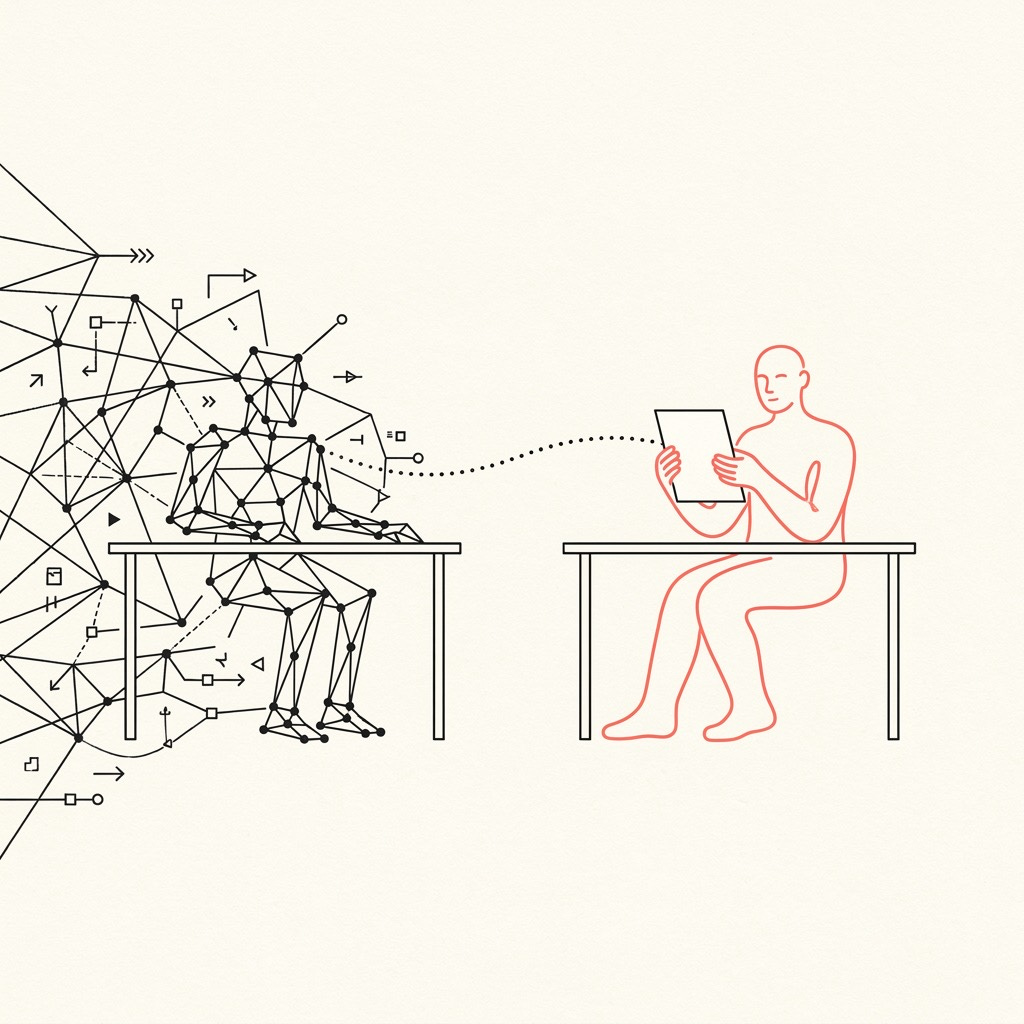
The Augmentation Gap
Organizations have already mapped AI augmentation
at the strategic level: HBR makes the business case for augmentation over automation
and at the deployment level: copilots, agents, role-specific tools.
But ask what personal AI augmentation looks like in practice, and the answers are thin: use better prompts, build more workflows, automate the repetitive stuff. Useful improvements. Wrong category.
Douglas Engelbart published his framework for augmenting human intellect in 1962. He was not interested in speed. His question was whether humans could comprehend more complex situations and solve harder problems than they otherwise could. The definition was about capability, not throughput. Sixty years later, that conversation is still relevant.
The Mechanism: A Second Brain That Compounds
The “second brain” - Tiago Forte’s term for an external personal knowledge repository - became a productivity buzzword over the past 10 years. Most people have heard it from a LinkedIn post or a colleague’s obsession.
The agentic turn changed what the concept actually means.
At the chatbot stage, the value came from querying the model’s knowledge. You brought the question; the model brought the information.
At the agentic stage, the structure inverts: the model maintains your knowledge. Stop deriving knowledge from scratch on every query. Let an LLM maintain a persistent, evolving knowledge artifact — a compiled wiki of what you know, updated continuously as new sources arrive. Andrej Karpathy — the AI researcher who led Tesla’s Autopilot program and is a former OpenAI scientist — explained this shift in early 2026; the implementation he sketched attracted over 31,000 GitHub stars in weeks. The idea named something that had no name: the second brain as infrastructure, not application.
This is no longer a pattern for engineers only. Anthropic’s Cowork and OpenAI’s Codex are both built on the same premise: let agents handle your knowledge infrastructure so you can focus on higher-order decisions.
This is not a note-taking app. Not a folder structure. Agent-maintained infrastructure means raw sources stay raw — articles, transcripts, reports, meeting notes, whatever comes in — and the agent does the work of ingesting, compiling, synthesizing, and updating. Each new input is evaluated against what the system already contains. Knowledge accumulates and cross-references. The system builds up a picture of what you know rather than a pile of what you’ve seen.
Cloudflare’s framing captures the distinction cleanly: search finds records; memory preserves what should carry forward. A second brain is memory infrastructure, not search infrastructure. Search returns everything that matches. Memory returns what has survived the test of relevance.
But how do you organize your “second brain” ? The answer depends on what you want to do with what you know.
An executive running a deal pipeline organizes differently than one building a research dossier. Tiago Forte’s CODE framework describes a second brain built to turn input into output, where every piece of captured knowledge is oriented toward eventual use.
An entity-concept wiki (think wikipedia) by contrast, is built for depth: structured nodes for key people, companies, ideas, and the relationships between them, designed for comprehension rather than production. Neither is the right default. The right structure is the one that matches the actual work.
What the second brain creates, then, is a knowledge artifact that grows over time — something outside your head that holds what you’ve learned, connected in ways that support retrieval and reuse.
But the system knows what you have seen. It cannot decide what you believe. Someone has to.
The System Editor
The infrastructure is only half the answer. The other half is who you become when you have it.
Without a named role, one of two failure modes takes over. The passive executive delegates everything: the agent decides what matters, what gets filed, what survives. The system grows in whatever direction the agent’s defaults push it. Or the overloaded executive tries to maintain everything manually, reviews every update, approves every synthesis — and the overhead swamps the benefit. Both fail. The first produces a system that reflects the agent’s judgment, not yours. The second produces a system you resent using.
The agent can operate in two fundamentally different modes. As librarian: filing, organizing, maintaining, keeping things current. As author: drafting, generating, producing. Most second-brain discussion, and most of the implementation literature — including Nicholas Spisak’s open-source implementation with its ingest, query, and lint workflows — describes the human’s job from within one of those modes. The LLM is the librarian; you’re the curator. Or the agent drafts; you approve. One role or the other.
The System Editor sits above both. Not the librarian. Not the author. The person who designed the system and sets the editorial standards. What gets in. What is believed. What is outdated. What gets upgraded from “seen” to something you’d stake a decision on. It is not a technical role and it is not a passive one. It requires active editorial judgment applied at regular intervals.
The work comes down to three recurring decisions:
What gets in : not everything deserves a place. The source standards you set determine the quality of what the system believes over time.
What becomes canonical : the editorial upgrade from “this was captured” to “this is what I think.” The moment a piece of information moves from the archive into your active model of the world.
What gets superseded : when new evidence changes what you thought, and something that was true is no longer.
In practice, this is a recurring review, not a daily overhead. The agent proposes what’s worth updating; you approve or reject. It takes less time than maintaining the system manually and more judgment than delegating it entirely. The session looks more like editing a memo than using a tool.
The editorial test is simple: did this update what I think, or did it just enter the archive? If the agent can answer that question on your behalf — if the system is deciding what you believe without your input — you have delegated the System Editor role.
You have become a spectator of your own knowledge.
Your company already runs this operation. Your company has editorial standards. What the brand believes, what is official, what is outdated, what gets revised when the evidence changes. Someone holds those standards. Without a person in that role, the organization produces contradictory positions, carries stale assumptions forward, and can’t distinguish what it believes from what it once wrote down.
Staying the Editor
AI augmentation is not a feature vendors ship. It is a discipline you practice.
The executives being genuinely augmented - holding more, deciding better, staying original under pressure — are the ones who decided what their knowledge system believes, and who keep making that decision.
The agent is the librarian or the author depending on the task. You are always the System Editor.
Second Brain Tools to Try
The second brain concept has moved from personal productivity blogs to commercial software. A few entry points, from most configurable to most turnkey:
Obsidian — Open-source, local-first, fully inspectable. I use this one. The most flexible foundation for an agent-maintained knowledge system. Requires configuration; the payoff is complete control over your data and structure. Start with Karpathy’s gist and Nicholas Spisak’s implementation for a working setup.
Notion AI — The familiar option. AI features are increasingly integrated; building a second brain structure requires intentional setup, but it works with existing workflows. Best for people who don’t want to change tools.
mem.ai — AI-native from the start. Automatic capture, automatic connection, minimal manual configuration. I didn’t try myself but it really looks good.
Anthropic Cowork — Agent-maintained knowledge connected to your existing work tools (Google Drive, Gmail, enterprise apps). Generally available since April 2026.
OpenAI Codex — Started as a coding tool; now expanding to general knowledge work and personalizing to role type — finance, product, marketing, operations. The CoWork competitor.
What makes it a job is the deciding. Before you can delegate anything, you have to encode what "better" means — which judgments the model inherits, which ones you keep. Skip that and you get something faster. Not something smarter.
Loved your reference to Engelbart!! Merci:)