


Imagine staffing a hospital with only surgeons.
Need a diagnosis? Surgeon. Medication management? Surgeon. Physical therapy? Surgeon. Radiology? Surgeon.
Absurd. Yet this is exactly how most people approach AI now.
Everyone wants “an AI team.” They build “an AI Center of Excellence.” They create “AI governance.”
As if the technology that predicts customer churn, the technology that drafts marketing copy, and the technology that autonomously handles customer refunds were the same thing.
They’re not. They share DNA, and ingredients, machine learning, data, algorithms. But they’re different beasts.
One Species, Different Beasts
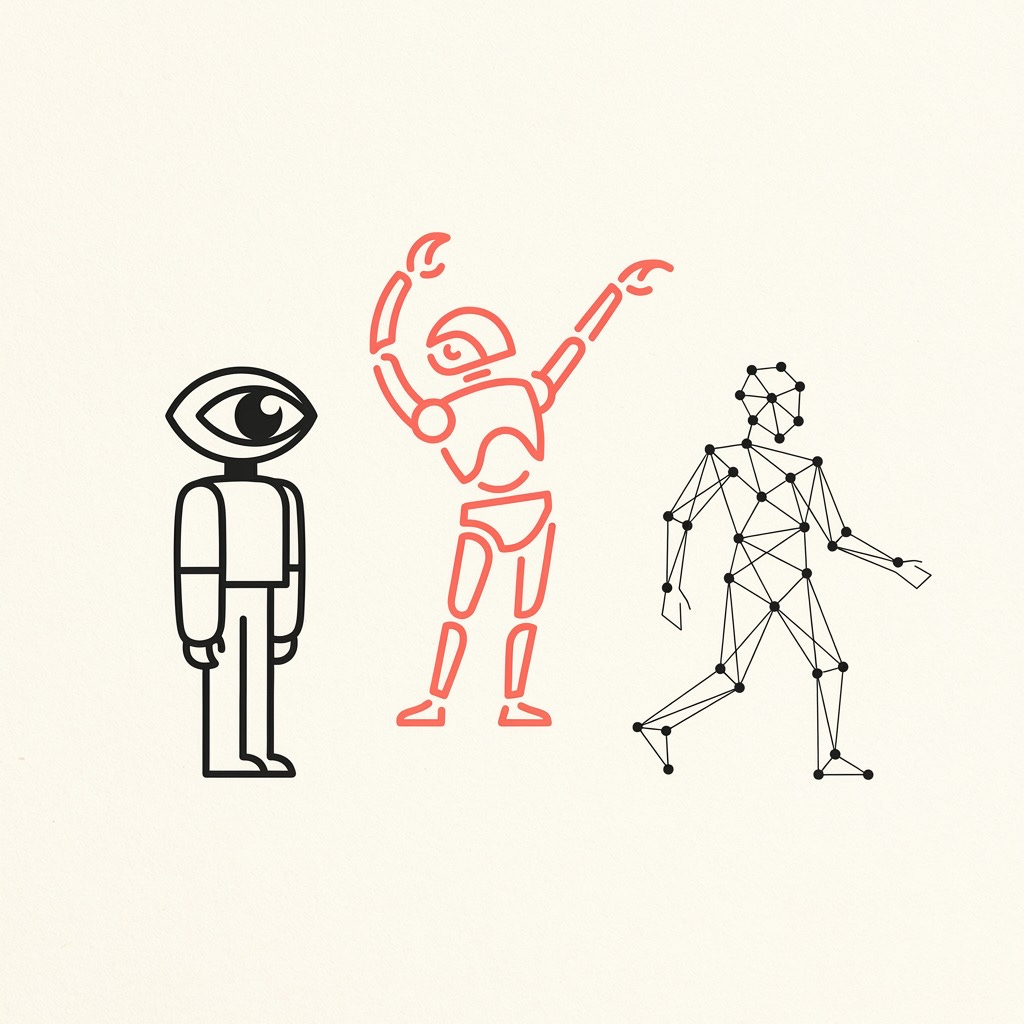
Three distinct paradigms hide under the single label “AI”:
The roles matter. Informs. Augments. Executes.
Each implies a fundamentally different relationship between human and machine.
Classic AI tells you which customers might churn—you decide what to do about it. GenAI drafts the retention email—you review and send it. Agentic AI decides whether to send it, to whom, and follows up based on responses. Your job shifts from doing the work to setting boundaries: ensuring the system is trustworthy and knowing what to do when things go wrong.
In banking, Salesforce describes how the paradigms compose: predictive AI forecasts fraudulent transactions, GenAI drafts personalized customer alerts, and agentic AI autonomously freezes suspicious accounts and initiates follow-ups.
This isn’t academic taxonomy. Gartner predicts 40% of enterprise applications will feature AI agents by end of 2026, up from less than 5% in 2025. A 700% increase in one year. Organizations that can’t distinguish between their three AI beasts will struggle to govern the fastest-growing one.
Three Beasts, Three Skill Sets
Each beast demands different handlers.
Classic AI needs data scientists and Machine Learning engineers who build and validate models. Statistical foundations. Understanding of bias and drift. This talent shortage is real but well-understood, it’s been an “AI skills gap” conversation for the past decade.
Generative AI needs what swyx calls “AI Engineers”, aka people who wield foundation models through APIs rather than build them. Many have never taken an Machine Learning course. They couldn’t explain backpropagation which is the core mechanism through which AI learns. But they ship products used by millions. The skill is data pipeline, integration, and knowing what these models can and can’t do.
Agentic AI needs something that barely exists yet: orchestrators who can redesign organizations around autonomous systems. Not just technical fluency but organizational design capability. As François Candelon ex BCG lead on these topics puts it, these are “people who can combine business judgment, technical fluency, and ethical awareness to guide hybrid teams of humans and agents.”
An ML engineer skilled at fraud detection models isn’t automatically qualified to design agent orchestration. A prompt engineer building chatbots doesn’t necessarily understand model risk governance. Skills don’t transfer automatically across paradigms.
In practical terms though, GenAI and AgenticAI are closer. Agentic AI is hyped because GenAI enables automation that was impossible until now. So Agentic AI might automate or redesign a workflow using GenAI. Who is going to design, program or govern the agents ? There are no established training paths for this. No career ladders. No bootcamps.
McKinsey found that 88% of AI users (including creators of some agentic automation) are nontechnical workers. The capability has spread far beyond any data science team. When it comes to generating a report draft, it’s not an IT engineering skill, it’s process design, prompting and clear thinking.
The Organizational Dilemma
No single team can own all three beasts.
IT can’t govern agentic decisions that affect customer relationships. Data science can’t oversee content safety for marketing chatbots. Business units can’t manage model risk for fraud detection.
The emerging pattern isn’t centralized vs. federated—it’s layered:
Centralized platforms and infrastructure
Paradigm-specific governance distributed to where accountability lives
Cross-functional councils for coordination
McKinsey finds fewer than 30% of companies report CEO sponsorship of their AI agenda. And only 21% of enterprises have mature governance models for autonomous agents. Centers of Excellence became sandboxes that insulated executives from strategic ownership rather than driving transformation.
Artefact warns of a “shadow management phenomenon”—employees deploying agents without HR-like oversight, because deployment is instantaneous and cost negligible. When anyone can spin up an autonomous agent, who’s accountable when it makes the wrong decision?
The organizations getting this right are asking a different question. Not “How do we use AI?” but “What would this function look like if we applied the right paradigm to each problem?”
That question requires counsel across teams. Cooperation between data science, IT, legal, HR, and business operations. Recognition that your ML engineers, your prompt designers, and your (yet-to-be-hired) orchestrators are solving fundamentally different problems.
Three Playbooks
The hospital analogy isn’t just illustrative.
Hospitals work because surgeons, diagnosticians, and therapists each do what they do best. Coordinated but not conflated. One patient outcome.
Your AI strategy needs the same architecture.
Staff for each beast. Your ML engineer who builds churn models may not be the right person to design agent orchestration. Your prompt engineer may not understand model risk governance. Build three capabilities, not one generic “AI team.”
Govern for each beast. Point-in-time model validation works for predictive AI. Real-time content guardrails work for GenAI. Continuous behavioral monitoring—with clear escalation paths—works for agents.
Move at each beast’s speed. Predictive AI moves at model-development pace (months to years). GenAI moves at application-development pace (weeks to months). Agentic AI moves at organizational-change pace (quarters to years). Organizations that try to deploy all three at GenAI speed will either over-engineer predictive systems or under-govern agents.
Same species. Different beasts. Match the playbook to the beast.
Great way to describe the paradigms. And I agree each one needs a different playbook.
Ok probably the best framework I've ever read to clarify the single question I need to answer when I'm training people on AI. Merci !