


“Nice work with AI,” they said.
I hadn’t used AI. That was the whole point.
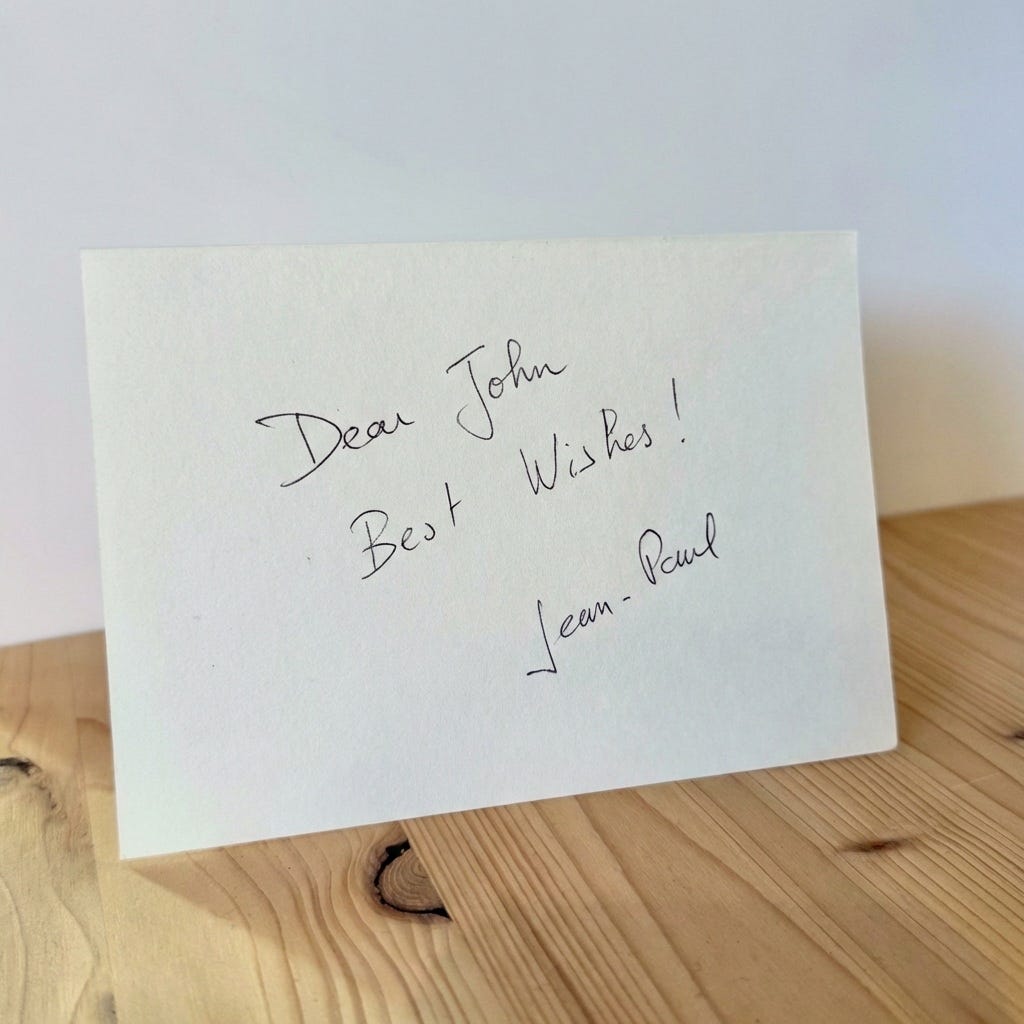
This year I sent a plain white card. “Best Wishes” written by hand, and a name, John, Sarah, Pierre inserted with AI. The name was the only thing AI touched.
A few people were delighted. But most assumed the whole thing was generated.
For a decade, I’d crafted elaborate greeting cards. Hours in Lightroom curating the perfect picture, Photoshop adjusting every pixel. When I had kids, carefully chosen vacation photos—happy kids on a beach, everyone smiling.
When Gen AI arrived, I jumped early into generating images that made friends ask “How did you make this?”
Each year, more digital effort.
This year, I went the other way. Minimal. Handwritten-looking.
It backfired.
When Polish Becomes Noise
When you give a gift, when you send greetings, you show care. The gift isn’t the object. It’s the signal.
With my children, for their grandparents’ birthday they spend hours making something imperfect: crafting a letter, folding origami, painting a card. We don’t say “let’s buy something expensive.” We say “let’s make something.”
The making is the meaning.
Those Photoshop hours weren’t about producing a nice image. They were proof that I’d spent irreplaceable time thinking about this greeting card. The labor creates the bond.
Economists call this “costly signaling.” As Munich Business School explains: “A cash gift is maximally efficient because recipients can buy whatever matches their preferences, but it is a ‘weak signal’ since walking to the ATM requires hardly any effort.” The powerful insight: sometimes inefficiency is the value.
In classic experiments, the same poem, painting, or suit of armor was judged more valuable when participants believed it took longer to make. The object didn’t change. Only the perceived effort did.
As economist James Andreoni puts it: “A carefully chosen book inspired by something a friend mentioned weeks ago says ‘I listened.’ A handmade card says ‘I care.’ A last-minute store voucher says ‘I panicked but I tried.’”
Companies give vouchers precisely because they don’t know you. The voucher is the gift of no relationship: efficient, impersonal, safe.
But effort only signals care when effort is still scarce. When AI removes execution effort, the polished output stops signaling anything.
The signal collapses.
So I adapted. Or thought I did.
The New Signal
The shift is big:
Before AI, how you made something mattered. Polish equaled effort equaled love.
After AI, that you thought of someone specifically matters. Selection equals intention equals love.
When AI can execute anything, what signals care isn’t the execution—it’s the decision that someone was worth your attention in the first place.
A handwritten note isn’t better than what AI could write. It’s yours. It carries the signal: I thought of you.
That was my theory, anyway.
The Backfire
The semi-manual cards went out. Clean, simple, personalized. “Dear [Name], Best Wishes”. And I added a short personal email or whatSApp.
Some people were impressed. It looks like “You took the time to write!” they said. The intention had landed.
But most people assumed it was AI-generated anyway.
The clean photo I’d carefully composed just read as generated. Even though I’d thought carefully about each card, even though the intention was real, the execution looked automated.
Call it Presumed Automated: in 2026, anything too nice is AI until proven otherwise.
The burden of proof has flipped.
So I went full manual for a handful of people. Actual pen. Actual paper. My actual messy handwriting. No scale, no efficiency.
Those cards landed best. By far.
Researchers call this the “Handmade Effect”: handmade products are perceived to symbolically “contain love.” People pay up to 17% more for handmade gifts, not because of quality, but because the imperfection signals that a human was present, caring, making decisions.
So in reality, intention isn’t enough. Effort and time still matter. The question isn’t “Is it fake?” or even “Did you mean it?”
The question is now: Can they tell it’s you?
The Wobble
A plain white card. A name in clean script. That looked like AI.
A messy note in actual ink. A signature that trails off the page. A wobble in the letters. That looked human.
The Wobble is the signal now. The imperfection that proves a human hand was here. The rough edge. The uneven spacing. The mistake you didn’t fix.
In 2026, perfection is noise. The wobble is the message.
If you want to signal care in a world of AI-generated polish, you need friction. You need proof of presence.
Go physical. A handwritten note beats any email. A phone call beats any message. Chocolate delivered to a client’s office beats any digital thank-you.
Go inefficient. The very inconvenience becomes the point. Flying to meet someone in person when a video call would “work” signals that they matter more than your time.
Go imperfect. Don’t fix the wobble. Don’t polish the rough edges. Let your humanity show through the cracks.
The things AI can’t counterfeit are the things that now carry weight: your physical presence, your voice, your handwriting, your time spent in the same room.
Over to You
What else can’t AI counterfeit?
What are your signals that still work, gestures, gifts, moments that can only be human. Reply with yours.
I will give full credit for the wobble.
References
Munich Business School - Gift Wrapping and Signaling Theory
Psychology Today - The Power of Gifting
JOM Media - The Warm-Glow Economics of Gift Giving
Journal of Marketing / ResearchGate - The Handmade Effect: What’s Love Got to Do with It?
I had a very similar experience. I like to spend a lot of time making custom birthday gifts. Things like short videos of the person, stickers with their most-used lines, funny screenshots, mini-books with all great things about them, all very personal and time-consuming. Last Christmas I also painted more than 10 cards by hand - each one different, reflecting how I see that person or what I think they'd like.
The effort I put in for these gifts didn't matter only to them, but also to me. Because putting that time in made me feel closer to them, like "I feel like I really value you". The bond deepened because of that, just like you described it.
And on the handmade effect - very real. All handmade things will increase in value the more we move into this world where AI can generate anything. It's like with all things - the more scarce something is, the more value it has.
GenAI has not changed the wabi-sabi effect. “ a way of seeing the world that finds beauty and harmony in what is simple, imperfect, natural, modest and mysterious. The Japanese aesthetic of wabi-sabi describes things of imperfect beauty, of a certain roughness, often small things that might easily be overlooked.” as defined by Cambridge dictionary.