


Read the announcements from AI labs and Big Tech and “Frontier” is everywhere. At Amazon with Frontier Agents, at OpenAI with Frontier, at Microsoft with Frontier Company and now Anthropic whose Frontier Academy trains, guess what, Frontier Deployed Engineers.
It seems Frontier is the new black. But what frontier are we talking about?
I’m guilty too. Last year I wrote about Frontier Fluency: knowing, from your own hands-on use, where AI shines and where it breaks. That was about one person. A company is a different story.
At an OpenAI event I attended, “frontier firms” were defined as those using the most tokens, tokens being the units AI usage is billed in. Convenient for them. And their own enterprise report defines “frontier workers” by how many messages they send.
So if the board asks for a frontier company, the yardstick on offer is a usage counter.
The word is part of the problem. Frontier sounds like exploration: the scout on the ridge, first to see the valley. And AI does look like the Wild West, with new territory every week, no global law, fortunes made and budgets burned.
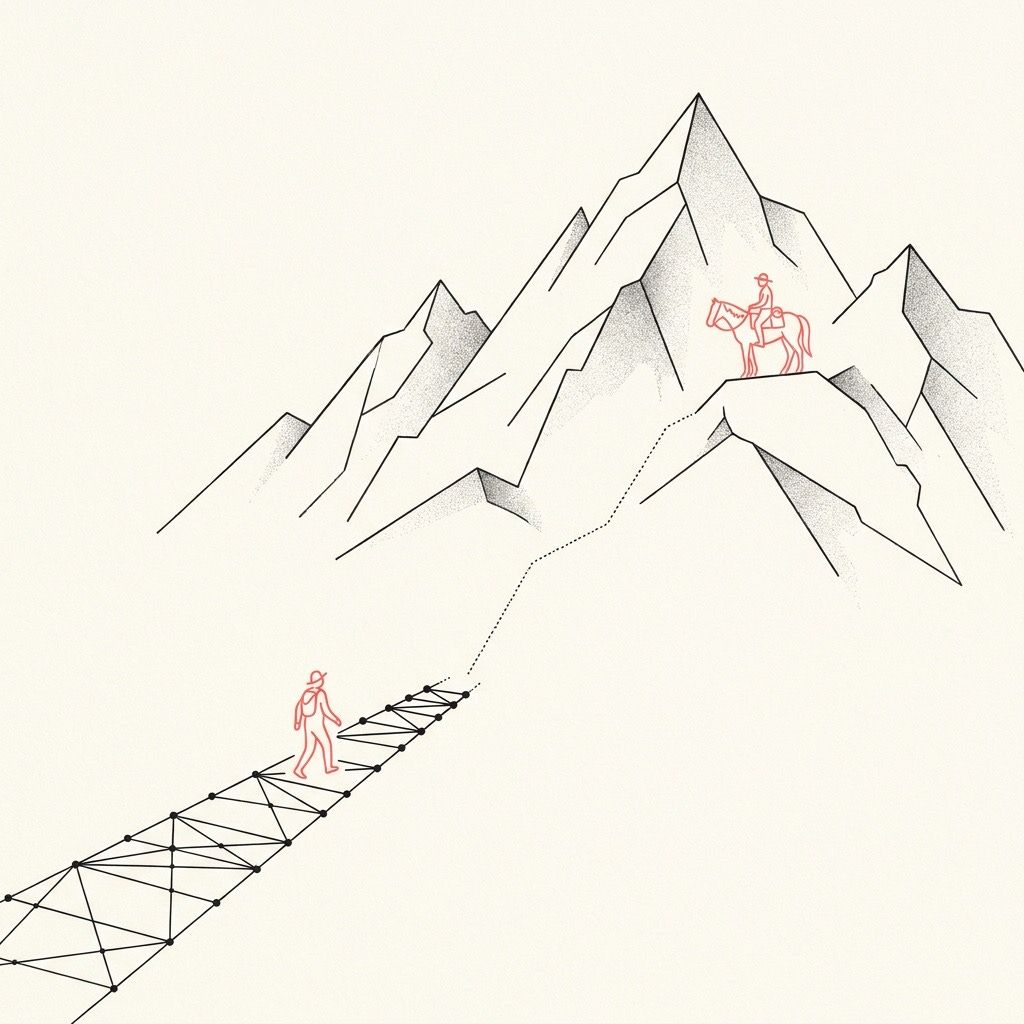
So I went back to the original frontier to see how it was settled. And it turns out the analogy is more powerful than it seems. Indeed, the scout got the legend. But the railway did the work.
The demo is the short part
Looking at AI transformation in large organizations, I keep seeing the same 3 distances.
The first is the demo. One curious person, a good model and a free afternoon. It works, the room applauds, and someone says the word “frontier”.
The second is getting one team to use it by default. Someone has to write down how it works, fix what breaks, handle the edge cases, and persuade colleagues who are convinced they were doing fine without it.
The third is getting many teams in many countries to use it. Other languages, local rules, and managers who never saw the demo. This is why change management exists, and why it never moves at the speed of the first distance.
None of this is news to anyone who lived through any transformation project involving new software. The software is the small bill. Getting people to work differently is the large one.
What’s new is the demo. AI has made the first distance so short and so spectacular that we tend to forget the other 2. Each distance runs on its own clock, and AI only sped up the first one.
The frontier was a procession
In 1893, historian Frederick Jackson Turner described the American frontier as a procession: the fur-trader and hunter first, then the cattle-raiser, then the pioneer farmer, “marching single file”.
AI has its fur traders. Andrej Karpathy, OpenAI co-founder and former head of AI at Tesla, sketches the funnel: about 20M professionals use frontier-grade models, and perhaps 5,000 insiders watch swarms of thousands of agents run whole projects, against 1-2B casual users. It’s the same in most companies: a handful of scouts, and thousands of people who aren’t.
A frontier firm is decided by what happens to the thousands. Even the vendors say so. In Microsoft’s 2026 Work Trend Index, organizational factors explain 67% of AI impact, against 32% for individual mindset.
Satya Nadella, Microsoft’s CEO, puts it in one line: “the real opportunity is not in picking the best model but instead in building a learning loop on top of models.” He talks about a “frontier ecosystem”. Keep in mind he sells the platform, though.
And to move the thousands, as on the American frontier, everyone has a role to play.
Scouts: give them a license to explore
Scouts still matter. Without them there’s nothing to deploy, and every large company already has some: the people trying agents on their own work.
They need permission more than budget. François Candelon, former head of BCG’s Henderson Institute think tank, offers 4 questions to draw the line between exploration that should be authorized and decisions that need governance. Is the decision reversible, routine, rule-bound, repairable? If yes, let people experiment. If not, add a human gate.
That’s the first clock, and the cheap one. The next one costs real money.
The railway: process and money
The original railway was the least romantic thing on the frontier: surveying, grading, timetables and financing. But above all, it took capital. The US government granted the railroads roughly 130M acres of land to get the track built. And the track moved with the edge: as it crossed Wyoming in 1867, towns appeared and moved with the railhead.
Inside a company, the railway tends to lose the budget argument. The scouts’ tools are a line anyone can defend: seats, a number that grows. In practice a railway means 3 written things: a description of how the task is done, a check that tells you when the output is wrong, and ready-made procedure and routine anyone can run including when things go wrong. The railway is people’s time spent writing things down. It will never be shown on a stage.
It’s also the only part that travels. A demo doesn’t survive the trip to the second country. A written routine does. That’s the second clock: how fast a routine spreads within one team.
Settlers: reasons to move
Settlers didn’t go west for the adventure. The railroads sold them land cheap and recruited as far away as Russia. They made the move worth making.
Your settlers are the teams who were hired, trained and rewarded for the old way of working. Their cheap land is a routine that makes the week easier, handed over ready to use, with the time to learn it.
Two things decide whether they move. One is what they see: Microsoft finds that managers who visibly use AI lift reported AI value by 17 points. People copy what they watch. The other is what gets rewarded. Reward activity and you get tokenmaxxing: people burning tokens to look busy. Get both right and the third clock, the slowest one, finally starts to move.
Watching the 3 clocks
Turner wrote that a century later, at South Pass in the Rockies, the same procession came “with wider intervals between.” In a company, that interval is the gap between scout and settler.
I call it absorption time: the days from the moment a scout’s experiment works to the moment it’s written down and other people use it by default.
You may want to set up 3 clocks, one for each distance:
How fast you experiment: the scout clock.
How fast a routine spreads within one team: the railway clock.
How fast many teams adopt it, across countries: the settler (or culture) clock.
This is a proposal, a way to put a stopwatch on Nadella’s learning loop. Like any number, it can be gamed. But it measures the distance that matters, which a usage counter doesn’t.
The railway is never finished
In 1890, the US census reported there could “hardly be said to be a frontier line” anymore, and Turner read that as the end of an era: the free land had run out.
AI doesn’t run out. New territory keeps appearing, so the railway is never finished and the scouts never come home.
So the next time the board asks for a frontier company, answer with a duration: how long a good idea takes to get from one desk to every country you operate in.
Working at the frontier means building the railway that moves your settlers as fast as your scouts explore.