


Every pitch for agentic AI ends in the same place: you’ll do less. The agents will handle the busywork, move the data, file the reports, and you will be freed for higher things.
It sounds like rest.
It is not. When the agents take the easy work, the easy work is gone. What’s left is the hard part, all of it, with none of the breaks in between. The copy-paste you’re so eager to automate was doing more than wasting time. It was letting your brain breathe between decisions.
Copy-paste was the easy part
Most of what we call knowledge work is shuttling data between systems. Pull the numbers from one place, reshape them, drop them in the next. Salesforce to spreadsheet. Spreadsheet to slide. Slide to email. A lot of it is moving information by hand because the software won’t move it for you.
This is exactly the work agents are good at.
We’ve watched automation reach for this work before and miss. Robotic process automation promised to kill copy-paste a decade ago by recording a human’s clicks and replaying them. Kimberly Tan at a16z explains why it disappointed: the scripts were brittle, shattering the moment a button moved. Agents don’t follow a recorded path. They read the screen, interpret messy inputs, and adjust when things change. Better still, Zain Hoda observes that agents now don’t click through your screens the way you do. They reach the data through APIs and skip the interface entirely.
Now look closer at the work that’s leaving. The reconciliation. The reformatting. The forwarding. Yes, it ate hours. But it was also the low-stakes part of the day, the stretch you could do half-awake on a Friday afternoon. It gave the brain somewhere easy to rest.
Every job has work like this. The lawyer skimming routine contracts before the one clause that needs real thought. The analyst formatting the deck before the meeting where the argument actually happens. We file all of it under “busywork” and resent it. We forget that it also paces us, spreading the cognitive load across the day instead of stacking it.
That hidden pacing matters. Brinda Sarathy and Rajeshwari Ganesan call it “productive friction,” and warn that stripping it out leaves teams carrying a cognitive debt. The dashboard says they are more efficient. In reality, they may be more brittle because many of those frictions were occasions to think and adjust.
The bar goes up
Picture a finance manager who spends two hundred hours a month stitching together Salesforce, the ERP, and a dozen spreadsheets. Hand all of it to agents and she doesn’t get two hundred hours of leisure. She gets two hundred hours that refill with the only work left: the analysis, the calls, the judgment.
The job did not get lighter. Now it is hard thinking, end to end.
This is the pattern playing out across knowledge work, and the people doing it can feel it. IT workers report that AI is making their jobs more demanding. The economics point the same way. Research summarized by MIT Sloan finds that when automation absorbs the routine, human effort concentrates on the hardest-to-replace tasks, and the value of that remaining work rises. Rising value is good news for wages. It is also a polite way of saying the work that’s left is the work that’s hard.
I’ve argued before that we misread what these tools are. We expected a speed machine and got a depth machine instead: the best users don’t spend less time, they spend more, because the easy tasks compress and the demanding ones expand to fill the space. The Microsoft data in that piece showed over half of AI-leading firms reporting more work, not less. What looks like efficiency on a slide becomes intensity in a calendar.
There’s a deeper reason the remaining work is harder, and it isn’t just volume.
When a system can generate a dozen plausible answers on demand, the bottleneck moves from producing to choosing. Cassie Kozyrkov calls this the problem of endless right answers: the machine hands you a thousand competent options and cannot tell you which one matters. That call is judgment, and judgment doesn’t get easier with practice the way operating a system does.
So in the end, you swap low-stakes effort for high-stakes effort. That can be a good trade. Higher-value work is more interesting, often better paid, and harder for the next person to replicate. But it is a trade, not a gift.
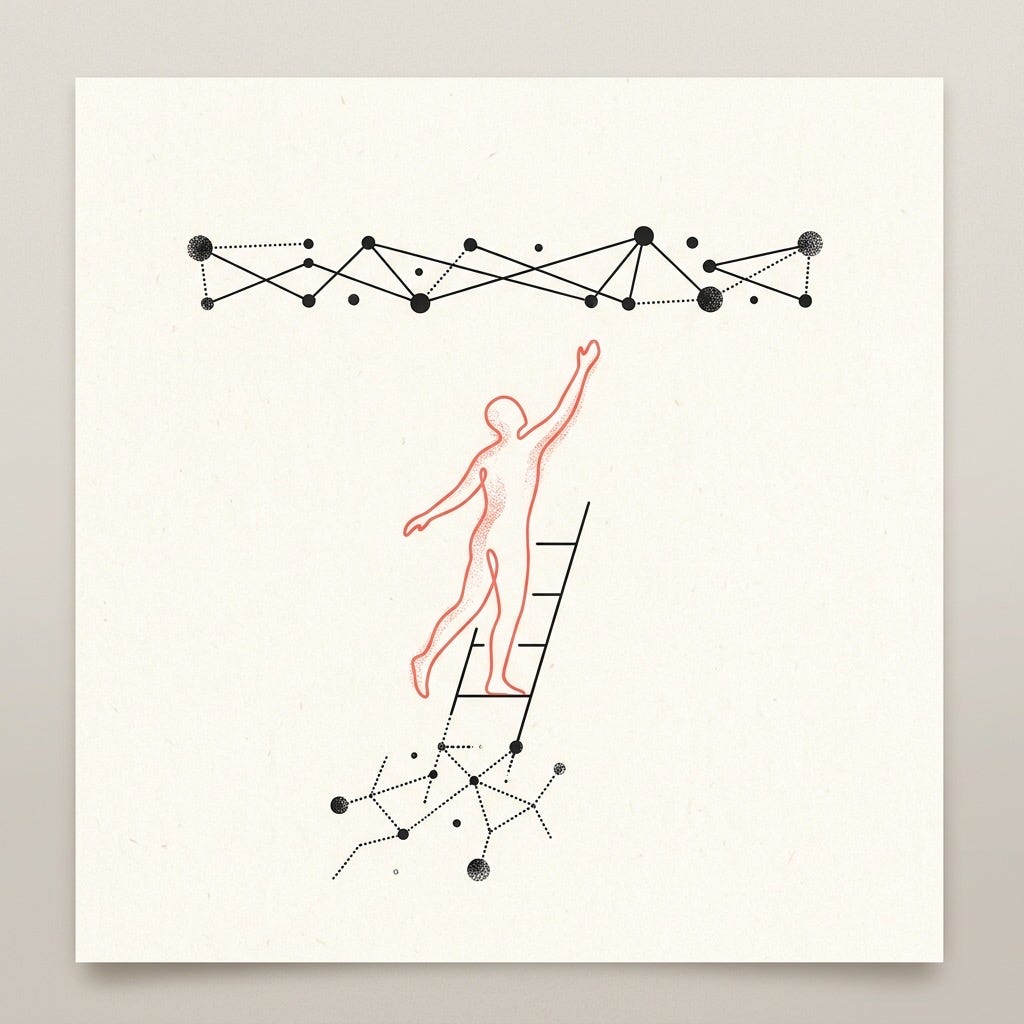
There’s a second cost, and it’s slower to show up. The easy work was also how people learned. A junior role is an apprenticeship disguised as a job: you write the boilerplate, summarize the documents, run the reconciliations, and over a few years you absorb the logic of the system well enough to make the hard calls yourself. Anastasia Stasenko points to the catch hiding inside the efficiency: AI is replacing the very tasks that used to make people senior, and Anthropic’s data already shows a 14% drop in hiring for workers aged 22 to 25 in AI-exposed occupations. Automate the bottom rung and the bar doesn’t just rise. The ladder up to it gets pulled away.
Leading when the floor is gone
If the work that’s left is relentless judgment, the leader’s job changes shape. The old skill was making people faster. The new one is deciding what is worth the intensity, and protecting people from a day that is now all peaks and no valleys.
Start by seeing the cushion before you remove it.
Map the work agents are about to absorb, and ask not only how many hours it costs but what role those hours played. Some of that shuttling was waste. Some of it was recovery time. Some of it was the inspection layer where people noticed that the numbers felt wrong.
Then decide what the freed capacity is actually for. François Candelon, writing in Fortune, argues the new leader has to combine business judgment, technical fluency, and ethical awareness to direct hybrid teams of humans and agents. That is true, but it can sound cleaner than it feels. In practice, you are designing what a human day should hold when only demanding work remains.
Kristin Burnham at MIT Sloan frames the central choice as retrofitting versus reengineering. Most companies will retrofit first. They will add agents to the current workflow, pocket the apparent efficiency, and refill every empty hour with more targets. Reengineering asks a harder question: what does a sustainable judgment-heavy job look like?
That question has three parts.
What cushion are we removing?
What bar are we raising?
What ladder are we preserving?
Miss the first, and people burn out. Carla de Preval frames this as an asymmetric race against systems that never tire: benchmark a human against the machine’s pace and the human loses every time.
Miss the second, and the extra intensity gets wasted on work that did not deserve it. Miss the third, and juniors lose the path that teaches them how to become the seniors.
AI doesn’t lighten the load. The easy work was hiding how demanding the real work always was. Now there’s nowhere to hide.
The teams that thrive will automate with care: enough to raise the work, not so much that the people doing it lose the rhythm, apprenticeship, and recovery that made the work possible.
I think this is also what can happen in the teaching profession as well - though many teachers currently use AI in a simple enough way to be seen as a time-saver (creating individualized worksheets for students, generating lesson plans, etc...), I think as more and more begin to experiment with agentic systems, this will also start to happen. An increase in possibilities means you can do things you never considered before which means spending more time not less on aiding students. This may have a net benefit overall, but I agree with the general principle that, though counterintuitive, AI may not make necessarily make us more efficient. I wrote about this last month.
https://fitzyhistory.substack.com/p/the-myth-of-ai-time-savings
"The bottleneck moves from producing to choosing." That's great. I'd add one thing: choosing well is a skill that atrophies when you stop practicing it. Most people using AI are automating the iteration, meaning the back and forth, the rejection and the refinement, which is exactly where creative judgment develops. The efficiency gains are real. The skill loss is quieter and slower to show up. By the time you notice it, you've forgotten what good felt like.