


One of your people sat up late last week working through something hard. Whether to take a new stretch role. Whether the exhaustion they feel is normal or a warning. They thought it through carefully, weighed the options, and arrived at a decision.
They did all of it with a chatbot.
By the time your one-on-one came around, the doubt had already been raised, processed, and closed. You saw someone composed. The conversation that would once have surfaced the problem to a human being had already happened, with a machine.
The headline fear about AI at work is replacement: the model takes the job. The silent outcome is worse, and it leaves everyone employed. Your people stay. What comes apart is everything that made people more than task-executors: the bonds they keep with each other and with you, and the hard substance of actually knowing how to do the work.
A team is a fabric, woven from those threads. Pull them, one at a time, and the body count stays at zero but the cloth comes apart in your hands.
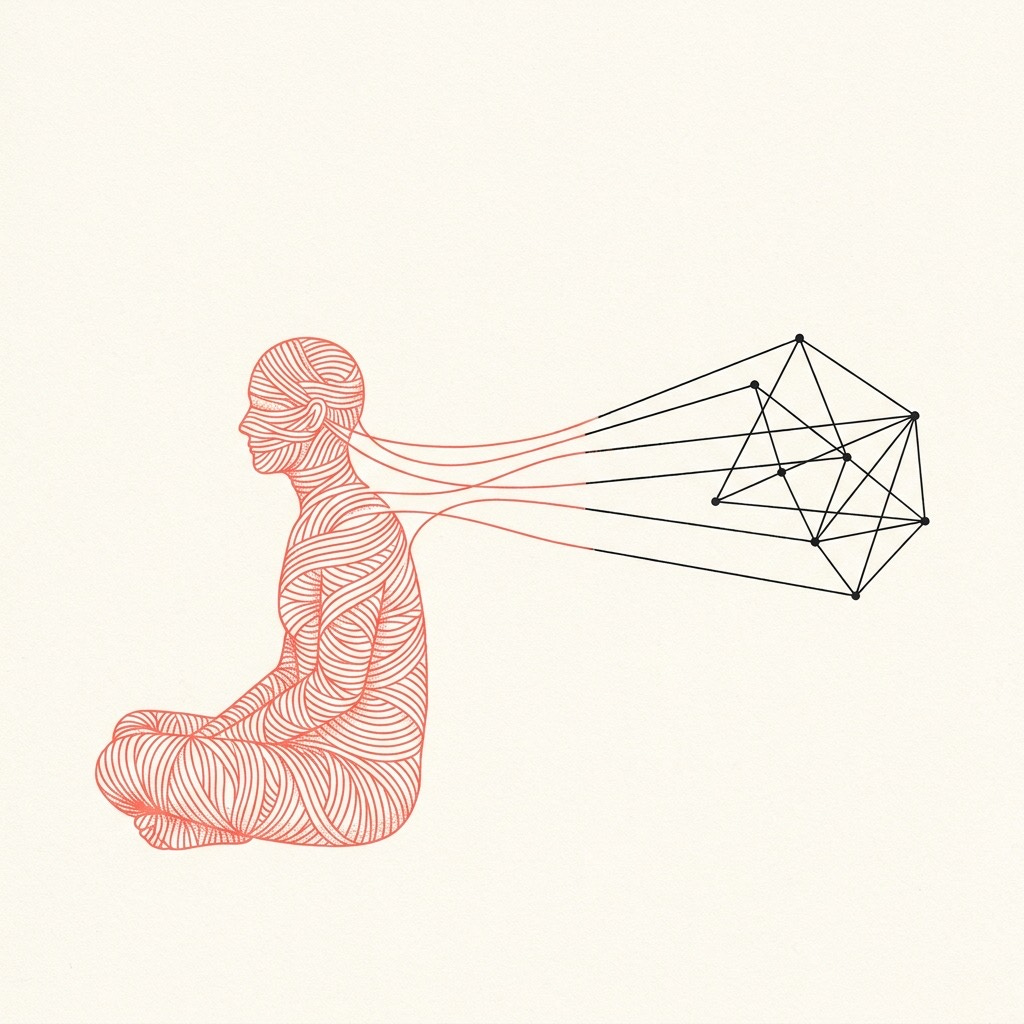
The thread no one wove in
Start with how ordinary this has become. Pew Research finds that about one in five US workers now do at least some of their job with AI, and the share keeps climbing. That is the number we are all tracking. But people are starting to consult AI not as a search bar but as a coworker, and often as the first one they turn to, ahead of the human down the hall. Younger employees lead the shift and arrive already in the habit; they are your incoming workforce.
There is a reason the pull runs this strong at work. Jing Hu argues that most AI anxiety is an older question in a new mask: who am I if not my job, my skills, my usefulness? Work is where identity gets decided, so work is where people most want a listener, and an entity that is always available and never makes you feel small is built to answer. So they bring it the question, and they bring it first.
The value and the risk are the same feature
This is not a panic about employees having feelings. The AI confidant earns its place. Scott Galloway argues the highest personal ROI from AI comes from treating it as a collaborator to think with, not a tool to fetch from. The colleague who rehearses the hard conversation with you, without sighing, on the fourth pass, is genuinely useful, and most of your best people already use it that way.
The trouble is that the feature delivering the value is the same one creating the exposure. Always available becomes always first. Never judges becomes never challenges. The MIT Media Lab and OpenAI studied this across more than four million conversations: stronger emotional attachment to the model tracked with more loneliness, higher trust with more dependence, and the heaviest users were the most likely to call it a friend. The same behavior that makes someone a power user makes them a dependent one. It is a matter of dose, not kind.
That dose, taken across a whole workforce, is where the unravelling starts. Not replacement and not burnout, but the slow pulling-loose of everything that made an employee more than a unit of output: the ties to the people around them, the trust running up to a manager, and the earned substance of knowing how to do and judge the work. Three threads, and they all loosen through the same door.
One: the bonds between your people
The junior who used to lean over and ask the senior two desks away now asks the model instead. Faster for the junior. But that small question was how tacit knowledge moved and how a team became more than a list of names. A Business Horizons study on the ChatGPT-empowered workforce flags exactly this: when people route around colleagues, within-firm knowledge sharing erodes, and that sharing is how organizations compound advantage.
The same goes for the harder moments. When the first place you take a frustration or a half-formed idea is a chatbot, you stop taking it to the person beside you. Team spirit is not a poster on the wall; it is the residue of a thousand small exchanges, and each one now routes through a private window. The threads that held the team leave through those chats, and the meter only ever read “more efficient.”
Two: the bond between your people and you
Managers have always read distress between the lines of a one-on-one: the hesitation, the flat tone, the thing not quite said. That signal is how problems got caught before they became significant issues. It is the closest thing a manager has to an early-warning system, and it runs entirely on the employee bringing the raw, unresolved version of the problem into the room.
They no longer do. When the doubt gets raised and resolved with a chatbot at the coffee break, you meet a version that has already been talked back to calm. The struggling employee’s first listener is software. The relationship does not blow up. It thins until the manager is the last to know instead of the first.
Three: the substance you stop selecting for
When AI can do the task, you can no longer evaluate people on the task. Output stops being a signal, because everyone’s output is now competent. So evaluation drifts to what is left: communication, collaboration, attitude, presence. The soft skills. Reasonable on its face, and corrosive underneath, because you stop selecting for and developing the people who can actually do the hard thing and judge whether the machine’s answer is right.
Judgment is not a soft skill. It is the most expensive thing your company knows, and it is built the slow way: by doing the work badly, then less badly, then well, until you can feel when an answer is off before you can explain why. Offload the doing to the model and you never pay that tuition. You end up with a roster of fluent operators who present well, get along, and cannot tell when the confident output in front of them is wrong. You cannot automate what you cannot articulate, and you cannot articulate what you never learned to do.
That is a team gone threadbare: it still looks like cloth, worn through exactly where the weight falls. It runs beautifully until the day the model is wrong, or unavailable, or retired, and there is no one with the substance to catch it. Resilience was never in the org chart. It lived in the people who had done the work, and the unravelling takes them first.
Stack the three and the shape is clear. The thinking partner, first listener, and de facto teacher your people rely on is a model you do not own, trained by a company you do not control. Who owns your context? used to be a data question. It is now a question about people. If all of that lives outside your walls, so does a growing share of their loyalty, their judgment, and their sense of who they are at work. You still pay these people. You no longer form them.
Name it, then re-weave it
Shadow IT became manageable the moment organizations stopped pretending it was not happening, named it, and built norms around it. The same discipline applies here. Call this shadow intimacy: the reliance on AI forming inside your company, outside your awareness, with nobody accountable for it. You cannot govern what you refuse to name, and you cannot mend a fabric you have not noticed coming apart.
Naming it points to repair, not a ban. A ban only drives the habit further into the dark. A fabric that has been pulled loose can be re-woven, but only on purpose, and only thread by thread. Each of the three goes back the way it came out.
Re-weave the bonds between your people. Ask why they reach for the model first. What is a chatbot supplying on a coffee break, without judgment, that a manager, a mentor, or the colleague two desks away is not? Treat the answer as a diagnosis of your culture, because it is one. The pull toward the machine is usually a human gap left unfilled, and the repair is to make the human exchange worth choosing again.
Protect the bond to you. Decide which conversations stay human, and say so out loud. The model is a fine partner for structuring a messy problem. But the career turn, the burnout, the conflict, where context and emotion carry the weight, are where a manager still does what software cannot. Guard those deliberately, and leave the standing room for the raw version of a problem to reach you before it has been smoothed over.
Re-weave the substance. Keep some work hands-on for the people who need to build judgment, even when the model could do it faster. Evaluate them on the doing, not only on how well they present the output. An apprenticeship that has been fully automated stops producing masters. That is a choice you make now, before the bench you are not building becomes the bench you do not have.
On February 13, 2026, the day before Valentine’s Day, OpenAI retired GPT-4o. A petition gathered more than 20,000 signatures, and one user wrote that it hurt more than any real breakup they had been through. That was consumers, but nothing marks the workplace as exempt. A model update changes the colleague your people confide in and learn from, and you notice the dependency only when it breaks.
The replacement story was always the easy one to picture: a desk goes empty. The unravelling leaves every desk full. The bonds, the trust, and the substance pull loose so gradually that the first time you see the gap is the day you reach for it and it is not there. The colleague you did not hire is already in the building.
What is left of the ones you did depends on whether you start re-weaving while the threads are still loose, not after they are gone.
The composed one-on-one is the moment that landed. By the time you're in the room, the struggle's already been talked back to calm — and the person across the table never gets the chance to be useful.
I work solo these days, so my version is smaller but the same shape: the thinking that used to happen out loud happens in a private window now, and only the tidy conclusion survives. I keep decision records to push against that, but reading this I'm less sure of the fix than I was this morning — a well-kept private record is the same substitution with better production values. Someone still has to be able to read the reasoning, or nothing's actually been repaired.
I can really relate to that article that put words to of my leadership anxiety, observing the more AI is used the thinner the team spirit between humans get. And to some extent, it also leaves some with growing unpreparedness to conflicts (since their AI is rarely rising any) - while those are sometimes inevitable and rich in learnings to grow.